
Changing the Flashlight Scoring System
For the first time in the 16 years I have been writing this blog I am changing a scoring system. Because of the nature of the change, it will be easier to implement than others. I will try to go back and update old reviews if they merit a change (i.e. they would be impacted by the change and the product is still being sold). Here is the crux of the problem.
The Problem
The flashlight market has changed dramatically in the last two years. The concern that prompted this change is simple—built-in batteries. These batteries represent the worst change to lights since the site started 16 years ago. And the change itself is accelerating. The number of lights with built-in batteries grows every year. Right now about 50% of enthusiast grade lights use built-in batteries. I get it. They are cheaper to make, they can have higher power levels for the same footprint, and they have fewer design constraints.
But the drawbacks are enormous for the consumer.
First, in a power outage, lights with built-in batteries are basically countdown timers. With traditional designs, you can deplete the main cell (hopefully a rechargeable) and then replace it with either a rechargeable or a primary. You can even purchase some replaceable cells at the store once roads are cleared but power is still out. Having lived through a few multiday power outages I can tell you this is not just a nice to have feature, but an essential requirement for a true EDC light. If your light can’t do this and you intend to use it in an emergency, you need to rethink your light.
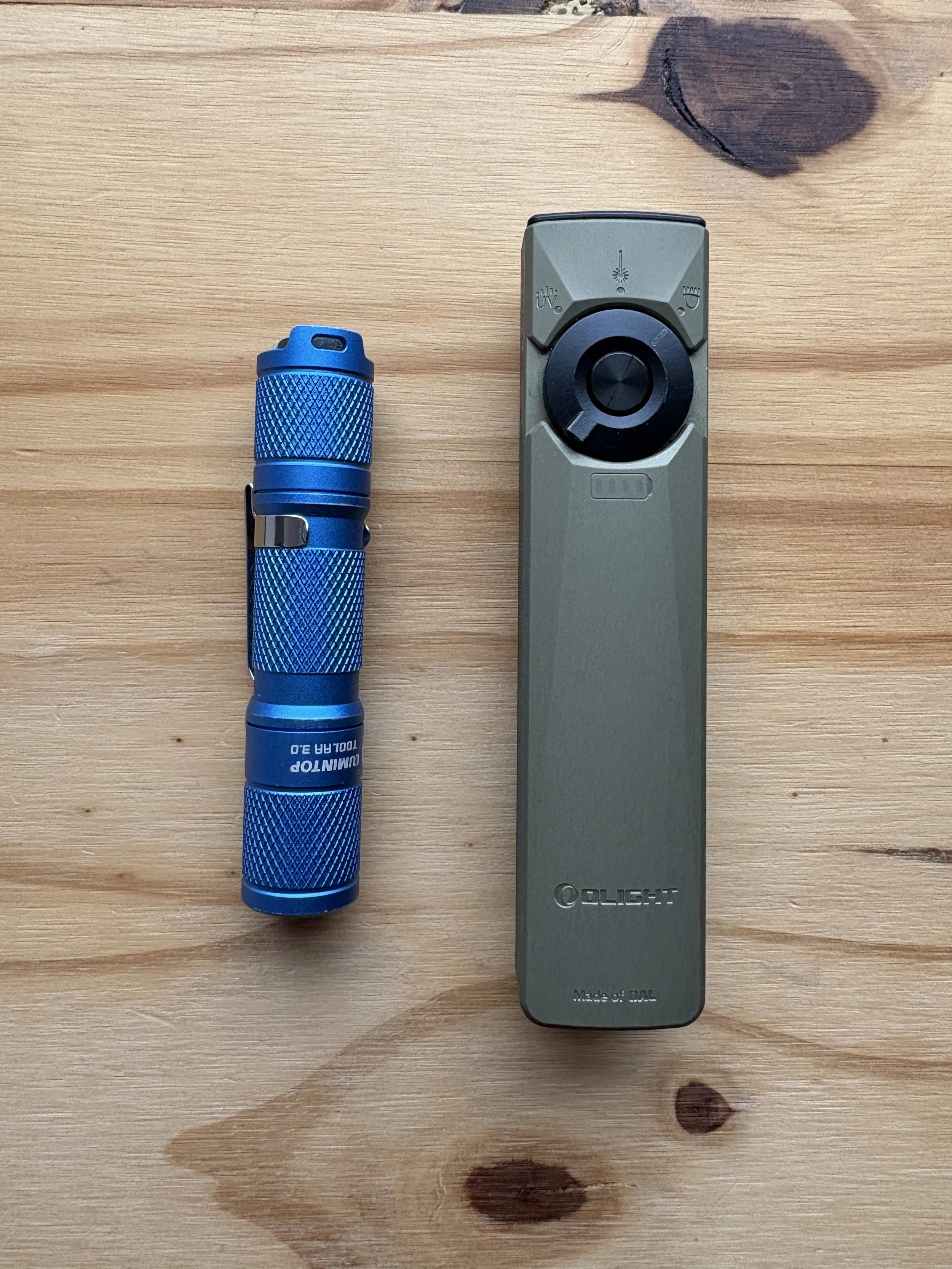
Second, lights with built-in batteries are essentially rental equipment. Once the battery dies, the light dies too. And a lot of these rental lights are very, very expensive. There are dozens if not hundreds of enthusiast grade lights that use built ins AND cost more than $100. I have had my McGizmo Haiku (which is dual fuel compatible and uses a replaceable battery that is somewhat readily available) for 17 years. It still works incredibly well. It was $500. The oLight Arkfeld Ultra has a warranty of two years on its internal battery. That light costs around $95.95. Being generous and giving the battery 5 years, that is still $300 in flashlights over the same time period. That makes the Haiku, which is a bananas-expensive light, look reasonable. Flashlights, since the debut of LEDs, have become so robust that normal use is not enough to require regular replacements. So the conspiracy theorist in me thinks that built-in batteries were a way of forcing users to buy new lights every so often.
Third, there is the EDC/Preparedness ethos. Part of that is items that are robust and can last forever with proper maintenance. Look through some of the crazy archives about the Sebenza and you will see 20 year old knives still working every day. The same is true with Rolex Submariners. EDC folks want stuff to last. Lights with built-in batteries, by design, do not last. Then there is this point—part of the EDC/Preparedness ethos is user serviceability. Again, look at the Sebenza—it is designed to be disassembled. Now not all our gear is like that, but most of it aims for that ideal. I have swapped out the emitter and engine on my Haiku and a few other lights (including an upcoming swap on a curiously good light with major problems—review soon) and I have swapped rechargeable cells multiple times. That is about as right to repair as it gets with lights. Lights with built-ins don’t do that.
TLDR: Unlike with fancy houses, built ins are bad when it comes to flashlights.
The Solution
I am going to merge the “Beam Type” category and the “Beam Quality” category into one category for “Beam.” I am going to then create a new category for “Battery.” In this category, a built-in receives a zero. A light which is not dual fuel but has a user-replaceable battery gets a 1. A dual fuel light that uses readily available batteries that are rechargeable will get a 2. The best configuration, in my opinion, is something like the Lumintop Tool AA v3. This light uses a single 14500 lithium cell for all the power and runtime enthusiasts want, but the 14500 is the same size as an alkaline AA. The included 14500 has a built in USB-C charging port. So what we have is this set of features:
Single cell
Dual fuel
Lithium rechargeable included but compatible with store bought cells
BUILT IN USB-C charging port
This gives you a light that is designed to run forever—between the tool-less charging and dual fuel compatibility with AA cells, the Tool AA v3 is just about perfect in the battery category and would earn a 2. I love this light more each day, for what it is worth.
There it is—the first change ever in the scoring system. Part of this is because the beam category with the advent of TIR optics is harder to differentiate. But most of this is motivated by market changes in the batteries for lights. We need to fight back against the built-in battery money grab. Its terrible.
Amazon Links